


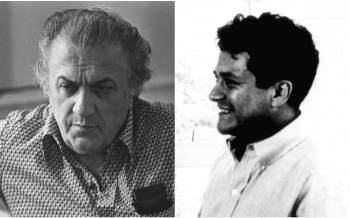
 RU MARSHALL
THE FELLINI PROJECT
There’s a term to describe the story of the encounter between Federico Fellini and the faux-anthropologist Carlos Castaneda that I’m about to tell. That term is “epistemological clusterfuck.” I know it happened, I know its rough outline. But among the eyewitnesses, there’s almost no concurrence about the details. It’s a tale that makes Rashomon seem almost a positivist tract.
By 1984, when the two master fantasists met, Castaneda’s fame had begun to fade. He had risen to international acclaim with the publication, in 1968, by the University of California, of The Teachings of Don Juan: A Yaqui Way of Knowledge, which purported to tell of the young anthropologist’s apprenticeship with Don Juan, a Yaqui Indian shaman. Who, using three psychotropic plants, Datura, Peyote, and mushrooms, had introduced Castaneda—then still a graduate student at UCLA—to a mode of cognition never before shared with a “Westerner.”
The Teachings and the two books that followed—A Separate Reality and Journey to Ixtlan—weren’t only enormous nonfiction bestsellers, they also received rave reviews—form The New York Times, Harpers, and The Nation. Carlos cultivated an aura of mystery. No one knew what he looked like—he refused to allow his picture to be taken—or where he lived. He had countless admirers not only in academia and the counterculture, but also in the arts. These included Joni Mitchell, Bob Dylan, John Lennon—who, in his last interview, referred to Yoko Ono as his “Don Juan”—and Nobel Laureate Octavio Paz, who wrote the introduction to the Spanish language edition of The Teachings. Other admirers included the philosopher Gilles Deleuze and the filmmaker George Lucas, who drew inspiration from Castaneda’s writings while writing the original Star Wars script. Those academics who were skeptical largely kept their doubts to themselves. Then, in December 1972, in a letter to the editor in The New York Times, Joyce Carol Oates became the first public intellectual to question whether the books that were being hailed as revolutionary contributions to the field of anthropology were, in fact, novels.
The following year, Time Magazine published a quasi-expose revealing that Castaneda had lied about almost every aspect of his personal life. This did not deter UCLA from granting Carlos his PhD eighteen days later, nor did it persuade the University of California Press, or Castaneda’s new publisher, Simon & Schuster, from continuing to promote his books as anthropology.
At the same time that Castaneda was writing his books, he was hard at work, all the while, on another project: assembling a highly secretive group of devoted women, some of whom would come to be known as his witches. Throughout the seventies and eighties, the group practiced martial arts, delved into the occult, and staged real-world performances that Carlos sometimes referred to as the “Theater of the Real.” By the time the group went public in the nineties, it was a full-fledged cult. Carlos and the witches, including two former UCLA anthropology students, Florinda Donner and Taisha Abelar, held workshops and seminars around the world, in which they taught Tensegrity—a movement technique they claimed had been passed down by twenty-five generations of Toltec shamans. The movements were often made up in a hotel room just prior to going on stage. Carlos, Florinda, Taisha, and the third witch, an acupuncturist named Carol Tiggs, hinted that Tensegrity would bring not only increased agility but maybe, just maybe, eternal life.
Thousands came to see the show.
Why, Castaneda’s defenders had argued, in the seventies, when allegations of fraud had first arisen, would anyone go to so much trouble? What they couldn’t have known: Carlos liked going to a lot of trouble. And his fantasies grew more and more baroque over time. Like many in Los Angeles, Castaneda had always been obsessed by the movies. His knowledge of cinema had long impressed his Hollywood acquaintances. And his favorite director, friends recall, was Federico Fellini.
Who, as luck would have it, was a giant fan of Castaneda’s. Throughout his life, Fellini had been fascinated by the occult. As part of this search, he’d once tried LSD but had been disappointed by the results. He’d used the I Ching, devoured Jung, and had tried to develop his ESP. When he read The Teachings, soon after it came out, he became an immediate and devoted aficionado.
By the eighties, Fellini’s greatest work—La Dolce Vita, La Strada, 81/2—was behind him. He feared he was now unable to do anything but repeat himself. But one project promised a way out. He wanted to make a film of The Teachings. He’d tried for years to get through to Carlos. But all his attempts had seemed to disappear in a maze. He discussed the matter with producer Dino De Laurentiis, who, according to Fellini, contacted Ned Brown, who (according to Fellini) demanded a million dollars for the rights to each book.
But then, in 1984, he was finally able to make contact via the Mexican actress and anthropologist Tiahoga “Yogi” Ruge. Fellini wrote to Castaneda, telling him of the travails he’d undergone trying to reach him, how fascinated he was by the story of his mysterious initiation into the world of sorcerers. In one of the many contradictory versions of this tale, they met first in Rome, where Fellini tried to persuade Castaneda they should make a film together at the Cinecitta studio. But Carlos said no. They had to go to the Sonoran Desert. So a plan was made: Fellini, accompanied by the Italian novelist and journalist Andrea De Carlo, would meet Castaneda in Los Angeles, then depart with him to Mexico, where they’d meet Don Juan. Andrea would, in Fellini’s vision of the trip play the role of the skeptic, something he’d done before on pilgrimages Fellini had made to various mediums. The adventure would be funded by Alberto Grimaldi, the producer of Last Tango in Paris. Grimaldi’s son Maurizio would accompany them.
Fellini didn’t like to travel. Andrea, who tells this story in his lightly-fictionalized novel Yucatan (and elsewhere), recalls Fellini, flying over the Atlantic, speculating—eagerly, fearfully—about the hallucinogens Castaneda would give them, the rituals in which he’d ask them to partake. Fear and desire, he reports, lit up Fellini’s eyes. According to Andrea, Maurizio met them at LAX, drove them to the Beverly Hilton. After checking in, they found, in Fellini’s room, a handwritten note with an enigmatic warning: “Attention, wrongly directed, is dangerous, because it rebounds. We are watching you.”
In the lobby (in Andrea’s version), the Italians meet Carlos. He’s short, plump, full of exuberance. His hair’s dyed black, he’s wearing white, and has a walking stick. With him are two women—likely Florinda and Taisha. They’re also dressed in white. Andrea thinks they look like two pale nuns. Castaneda introduces them as his “proselytes.” One of them tells Fellini they’ve seen all his films twice. But Fellini’s focus is firmly on Carlos.
Fellini’s entourage piles into Castaneda’s white VW. Carlos drives them to lunch. At the restaurant, Castaneda orders lobster. He seems excited, waves his short arms, asks detailed questions about Fellini’s films. He tells him how, years earlier, he’d gone with Don Juan to see La Strada. Don Juan had told him he’d one day have to meet the film’s director. Fellini tells Carlos that he envies writers. They don’t have to be in the public eye. Don’t have to share themselves. Carlos replies that anyone can do this. Anyone, he tells him, can not exist. Fellini asks when they’re going to leave for Mexico. Whenever he wants, Carlos replies. How about tomorrow? Fellini is amenable. Shows Carlos the strange note. Carlos tells him he doesn’t pay attention anymore to such things. They happen all the time. They’ll meet again that night.
Back in his room, Fellini finds, on the floor, another note: “Those who, instead of trying to understand, only seek confirmation of what they think they know, run the greatest risk. We are watching you.”
Maurizio helpfully suggests this might have something to do with Don Juan. That night, they have dinner with Carlos at the Trader Vic’s in the hotel. The mood is more serious than at lunch. Fellini tells Castaneda there’s been another message. Maurizio asks Carlos who he thinks is behind it. Carlos replies that the world is full of lunatics. Fellini then asks Castaneda to describe “the world beyond.” It’s a completely empty room, Carlos tells him. There’s nothing to recognize. Only absolute black. To Fellini, this sounds terrible. Why? Castaneda asks. Terrible, he tells the director, presupposes a series of references that have no meaning in this other universe. A dark room is only terrifying compared to the outside world. The secret, Carlos continues, is to know that everything is insignificant. Love, relationships, desires, plans: just bits of kitsch scattered around.
The table grows silent.
The next morning, the Italians meet Carlos in the lobby. Seeming frightened, he tells them his car was followed the previous night. There were two cars, he reports. They kept the same distance: fifty feet. Maybe, he speculates, it was the CIA. He almost crashed; they chased him down Sunset. The messages Fellini has been receiving are omens, he tells the director. It’s much too dangerous for him to go to Mexico.
Maurizio seems distraught. This is absurd, he tells Carlos. They’ve spent months making the arrangements. Fellini has come all the way from Rome. Fellini doesn’t seem so upset. Seems mostly interested in observing Castaneda’s behavior.
What if they go to Mexico without Carlos? Maurizio asks.
Castaneda is OK with this. He gives vague instructions on the route they should take, then quickly departs. Fellini says he wants to go back to Rome. Maurizio again remonstrates: a lot of work has gone into planning this trip. The hotel loudspeaker asks “Mr. Fellini” to come to the front desk. Where there’s a message for him: IF YOU LEAVE THIS CONTINENT NOW NOTHING WILL EVER BE CLEAR WE ARE ASSISTING YOU.
The aliens—or whoever it is who’s sending the messages—use all caps.
Fellini, Andrea, Maurizio, and Maurizio’s girlfriend, Sophie—a ballerina, model, and spiritual seeker—depart for Mexico. On the first day they make it almost to La Jolla. They spontaneously decide to stay at a hotel where, it turns out, they already have reservations. The weird missives continue. Fellini’s phone rings. An electronic voice delivers an innocuous message, welcoming them to the hotel. Fellini freaks out, but appears to Andrea to enjoy being freaked out. Maybe he’s putting on a performance. But Maurizio’s panic seems to Andrea to be genuine.
The next morning, as they wait for the parking attendant to bring their car around, Maurizio looks up. “Oh shit,” he says. On a balcony, across the street, they see “a life-sized effigy of a hanged tiger, the noose held by the effigy of a monk …”
Grimaldi asks the parking lot attendant the meaning of this sinister tableau. There’s a baseball game coming up, he explains. The Padres are playing the Tigers. They set out. They cross the border and drive east to Mexicali, where, in Fellini’s words, they “take a few drags of peyote.” In the middle of the night, a knock on the hotel room door. Phone call for Fellini. A gasping robotic voice: “You may move across the geographical border, but you will never cross the boundary of consciousness.”
The next day, not knowing what to do, they wander Mexicali. They’re followed, in Fellini’s account, by a swarm of ragged kids. They go into a store and amuse themselves by trying on velvet sombreros. They leave the store, wearing their sombreros, and find another note on the windshield, with a message telling them that “the man who has left them … is lost in a fate of darkness and confusion.” They assume this refers to Carlos. Sophie leads them to a bar where, in Fellini’s account, she performs a freakish ritual in an effort to induce a trance through which she can telepathically contact her psychic consultant in L.A.
That night, at the hotel, another phone call: They can go back to Italy. Or they can trust the “mysterious force,” which suggests they continue to the Mayan archeological site of Tulum. Here Andrea’s and Fellini’s narratives diverge. In Andrea’s, they return to L.A. and try to reconnect with Carlos. He’s not to be found.
Instead, they find Christina Engelhardt, an actress, chaneller, and sometimes-friend of Sophie, who invites Christina to dinner with Fellini and his entourage. When she was sixteen, Christina had begun an eight-year affair with Woody Allen (she was the model for the character played by Mariel Hemingway in Manhattan.) She worked, for a time, for Jeffrey Epstein. In 1984, she’d just moved to Los Angeles on the advice of her “psychic mother,” who didn’t think her situation in New York was all that healthy. She’d predicted that if Christina moved to L.A., she’d soon meet another famous director. At the dinner (again at Trader Vic’s), she and Sophie engage in a who-is-more-psychic contest, debating astrology and pulling crystals out of their purses (Christina wins, she has more).
After the dinner, Christina invites everyone to her apartment to see a slideshow of her recent trip to the Yucatan. They all go (except for Sophie, who has ballet class the next morning). They watch Christina’s slideshow, which is accompanied by George Winston music. Christina’s roommate, the horror film actress Brinke Stevens, walks in. She’s astounded to see Fellini sitting on their couch. She and Christina are now part of Fellini’s entourage.
The next day, the mysterious notes continue. Pay phones ring as they’re walking by. Fellini answers. The voice on the other end is strange, mechanical. From outer space? Another dimension? Fellini asks the voice if it has a name. It does. Its name is You.
You tells Fellini: “Your creative force is blocked and you cannot bring yourself to admit it, still less to admit the reason. Your work is a cold repetition of themes to which you gave intensity in the past, but now you use them like the ingredients in a recipe. The passion that drove you has been replaced by technical skill, sterile and irrelevant.”
Fellini is understandably upset. What they’re saying about his work is true, he tells Andrea. You then assigns them colors. Fellini: green. Christina: pink, Andrea: blue. Sophie is given white, Maurizio yellow. Brinke is violet.
You next instructs them to have sex with each other in certain specified combinations. Fellini, the green one, hopes he’ll be assigned Christina. Nope. They’re to sleep together, but not have sex. Christina is, instead, to have sex with Andrea. Fellini is unhappy, but accepts that there is a higher purpose to all of this. None of them seem comfortable with their assigned couplings.
Then, they receive another message, telling them they’re to fly the next day to Cancun, where more will be revealed.
In Fellini’s version, they don’t return to L.A. Rather, they head straight from Mexicali to Cancun, which Fellini finds appealingly exotic. “The atmosphere feels charmed. The night air is saturated with the aromatic scents of the jungle.” They check into their hotel. It has a waterfall, and is shaped like a spaceship. In each enormous room, exotic fruit, wrapped in cellophane. This seems to move Fellini deeply. They receive another mysterious call. You tells them to bathe in the sea at eight am. A curious passivity has by now set in; they follow You’s instructions and do so. It seems a life-affirming ritual. Back at the hotel, the manager, alerted to Fellini’s presence, makes a point of informing them that there are barracudas in the water. Two workmen have recently been eaten. There are signs everywhere, but preoccupied by the messages, Fellini and friends haven’t noticed.
You then instructs them to go to the Mayan archeological site of Chichen Itza, which it describes as “the negative center.” When they arrive, Maurizio tells them how, back in the day, the Mayans would sacrifice fifteen thousand men at a time. He goes on about the volume of blood that must have flowed, irritating Sophie. You has instructed them they’re to burn the messages they’ve received on an octagonal stone. They search Chichen Itza for such a stone, but the site is vast. Fellini cuts himself on a branch and starts dripping blood onto . . . an octagonal stone. A strange figure appears and asks: “Is everything alright?”
The next day, at You’s directions, they head to Tulum, “the positive place.” They have, there, a positive experience; everyone’s euphoric; when they get back to their jeep, Maurizio finds a note on the windshield that reads: “You will be in the city of Los Angeles at ten o’clock tonight … all will be clarified. We are assisting you.”
Madcap trip back to L.A. They check back into the Beverly Hilton. In the middle of the night, You calls Fellini. New instructions: in the morning, they’re to go buy clothes matching their assigned colors. Then they’re to buy musical instruments. At midnight, they’re to be in Fellini’s room, playing the instruments. (Christina and Brinke have some musical ability, the others have none.) Through the music, all will be clarified.
They go shopping. Fellini has a hard time finding an acceptable green jacket. The women have an easier time: white, pink, and violet outfits aren’t as hard to locate. The men grow irritated that the women aren’t helping them more. Maurizio can’t find anything in yellow. Then he does: shoes.
Back in the hotel lobby, another call from You. You’s displeased: shoes aren’t clothes. They panic. Fellini implores the salesgirl at the hotel store. They must have something. She ponders. They can have her boyfriend’s yellow windbreaker. They retrieve it from her minibus, then head to a musical instrument store. More frantic shopping.
Maurizio buys a saxophone. Andrea, a guitar. Fellini picks out a synthesizer. They buy an amplifier, a keyboard. They’re in his room at eleven p.m., with their newly purchased instruments, in their outfits, awaiting the revelation. Fellini goes into the bathroom. Emerges. Decides they should turn off the lights. All that’s visible: the red and green lights of the amplifier and the keyboard. Out the window, an opalescent glow.
Midnight comes. Nothing. Fellini suggests they play. Cacophony commences. Andrea finds it unbearable. A horrible, wretched farce. Fellini shouts for them to stop. Instructs them to play more softly. The second time, Andrea thinks, is even worse. He wonders if they are idiots or people playing the part of idiots.
A knock comes at the door. They stop playing. “It’s not locked,” the director says.
A large form appears in the doorway, backlit by the corridor’s lights.
A security officer. They’ve been getting complaints about the noise. Fellini’s disappointment seems immense. To Andrea, it’s like a failed space launch. Leaving the hotel, they avoid each other’s faces. They drive up the Pacific Coast Highway, not knowing where they’re going. Maurizio begins laughing convulsively. Some of the others join in. Not Christina. “Hold on,” she says, “This is real alien shit!” They pull into a ramshackle bar, order cheeseburgers. If it were a Fellini film, this would be the final scene. Dawn soon arrives.
But this wasn’t the final scene. During the months that followed, both Fellini and Christina continued receiving the strange calls. Christina: “I’d be walking down the street. A pay phone would ring. It would be them.” (You it seems, was sometimes plural). And, she recalls, it was the same for Fellini. “Federico and I were pretty much frightened into each other’s lives. It got wilder and crazier. Things would fly across the room.”
Fellini, too, would recall this. He wrote to Christina, asking her to visit so they could talk about what had happened, and was continuing to happen. For a while, she was back and forth between L.A. and Rome. One time, in L.A., the voice called and told her she had to get on a plane. “How am I going to get the money?” she asked. The doorbell rang. “I opened the door. There was a shoebox full of money. Exactly enough to buy a ticket.
“The voices clearly told us Castaneda wasn’t the way to go. That that wasn’t where the information was coming from. But for some reason, Castaneda’s energy was so powerful. There is a fourth dimension, and a fifth dimension, and things happen simultaneously, and somehow something reached us from there and made these phone calls.”
Sometimes she wanted to hide. “One time I flew to Rome. I didn’t tell anyone. I stayed in the most obscure hotel. I even switched rooms. Finally, I’m in room 303 at the Hotel de Raffaello. As soon as I walk in, the phone rings. The voices. They’re telling me what to do. I should talk to this person, shouldn’t talk to that person. After the phone call I called down to the hotel operator. I’d picked this hotel because it’s one of the oldest in Rome. They had an old phone switchboard, with an operator sticking the plugs in. I said, ‘that call that just came in, was it from inside or outside the hotel?” The operator told her there’d been no call.
Soon after this, she moved to Rome and went to work for Fellini.
Christina: “People think I’m full of baloney. They think I’m on drugs. In those seven years I had maybe thirty calls. Sometimes three or four a day, if they really wanted to get a message across. It got so intense. I’d pick up the phone, and as soon as I heard it I started sweating profusely. It was very physically draining. They’d tell me what to do. I did as they asked, and phenomenal things happened.”
In May1986, a series of articles by Fellini about his pursuit of Don Juan began appearing in the Milanese newspaper Corriere Della Sera. Fellini was staying at his collaborator Tullio Pinelli’s house. There, he received another mysterious call. He was instructed to include an epilogue stating “the events of the story really happened.”
He did. The calls stopped for a while.
Christina started working for Fellini. She was an assistant on Ginger and Fred and appeared in his 1987 film Intervista. In 1988, Fellini collaborated with the artist Milo Manara on a comic book version of the never made (as of yet) screenplay, Viaggio a Tulun. (Tulun is a misspelling—or a fiction—not a translation.) Fellini’s biographer Tullio Kezich reports that, while working on the story boards, Fellini received another call. He’d been planning to include an image of Castaneda in the book. He was instructed not to. He’d already made some sketches. He made sure they didn’t reach Manara. No likeness of Carlos appeared.
According to Kezich, this was the last call. Not according to Christina. One day, she recalls, “Federico called me up and goes, ‘There’s a bunch of people who want to meet you.’ This group—about six people, all Italians—was in his office. All suits and ties. They were saying, ‘We are the New Seers. We’re coming to get you and Christina to take us back to Mexico, because Carlos is no longer with us. You are to continue the legacy.’”
By the late eighties, a number of “sorcery houses” had been established around the world by Carlos devotees, one of which was in Italy. It’s not inconceivable that the group which came to meet with Federico and Christina was associated with this community. Christina: “They were a little bit rigid and a little bit scary. And insistent. They followed us for months, trying to convince us we had to enter their world, become their leaders.” Fellini told them no, but “they were very adamant … I couldn’t go anywhere. They were hiding in the bushes.”
One day, Christina recalls, Fellini was planning to leave on a trip. She was at home. The phone rang. The voice told her, “‘Call the Green One right now. Tell him not to go.’ I immediately call Federico. I hear him lift the phone. I go ‘Hello? Hello? Federico?’ He goes, ‘I’m picking up the phone to call the ambulance. I just fell down the stairs and broke my foot.’ I told him ‘The voices told me to tell you not to go.’”
In 1990 and 1991, Fellini spoke with the poet and art historian Toni Maraini about Castaneda. A topic, she’d recall, that he was reluctant to get into. It “provoked in him passionate and strongly felt emotions . . .” And questions. He told Maraini: “Phenomena and wonders popped up . . . I found strange messages in my room and objects moved around. I think it was black magic.” And, continued the director, “The one thing that fascinated and also somewhat alienated me … was Castaneda’s and Don Juan’s particular vision of the world. I saw something unhuman there…. As if I were confronted with a vision of a world dictated by a quartz! Or a green lizard! … you felt transported to a point of view never before imagined, never suspected, that truly had you . . . outside of your humanity, and that for an instant gave you an unfamiliar shiver of belonging to other elements, to elements of the vegetable world, animal world, even the mineral world…. there was no comfort… This was what made [the books] terrible and fascinating for me … I seemed to find myself in an asphyxiated world.”
The master fantasist died on October 31, 1993. Some have speculated that he was the one behind the mysterious calls, the strange messages. But all the evidence points toward Carlos. Only those in his cult’s inner circle knew that he had long made a practice of assigning his followers colors and then arranging couplings of these different “energetically” colored beings. Although he had no further contact with Fellini after telling him that he’d have to head to Mexico on his own, Carlos would later tell his followers about the voices. How did he know? And it’s clear the Mexican adventure left Fellini unsettled for the rest of his life.
Castaneda’s Theater of the Real had its origins in the work of his mentor and prime sponsor at UCLA, the radical sociologist Harold Garfinkel. Garfinkel, whose goal was to unveil the hidden rules that govern “normal” social interactions, orchestrated “breaching experiments,” small performances conducted by students, usually on other unsuspecting (and nonconsenting) students, in which the ordinary rules of daily life were disrupted. The reactions of those who’d been thus punked were observed. The longer the experiments went on, the more the subjects became, in the words of the sociologists Hugh Mehan and Houston Wood “like desocialized schizophrenics, persons devoid of any reality.” Castaneda’s disruptions, in his cult and in his Theater of the Real, went much further than Garfinkle’s. In them, he broke down the art/life barrier in a manner considerably more radical than Garfinkel had envisioned, not to mention Brecht or Grotowski (or, for that matter, Nathan Fielder). Most importantly, unlike Garfinkle’s experiments or the work of the experimental directors Castaneda admired, his productions never came to an end. All that said, the Fellini project must have required an extraordinary effort. How did Carlos pull it off?
After going over and over the often-contradictory reports of the main eyewitnesses, I could come up with only one conclusion. On July 31, 2012, I rang the doorbell at Maurizio Grimaldi’s home in the Pacific Palisades. (I’d written several times. No response.) A middle-aged woman answered. I asked for him.
Maurizio appeared, looking quite dapper for the middle of the day. Had nice shoes. I asked if he’d gotten my letters. He told me he had, stepped onto the lawn. Said he’d like to talk, but this wasn’t a good time. There seemed to be a tacit acknowledgement that the reason he couldn’t was the presence of the woman I assumed to be his wife.
He appeared a bit amused. Tempted to talk, but hesitant.
The private investigator with whom I’d been working, Jennifer Stalvey, had advised me that, when people said they didn’t want to talk, I should just keep talking. I started asking about the trip to Mexico. No, he told me, he couldn’t explain how the calls had come when they were staying at the hotel outside La Jolla. No one knew they’d be there. There was only one girl on the trip to Mexico, he told me. (Did he suppress a slight grin?) He couldn’t remember her name, he said. A dancer? I asked. He said he really didn’t remember.
Andrea De Carlo says she was your girlfriend, I told him. His expression changed slightly. Yes, he said. I’m starting to remember. Yes, he told me, the story about the musical instruments at the Hilton, that happened. He indicated he needed to go inside. We’ll make a plan to talk further, he told me. We’ll talk on the phone, he said.
I never heard from him again.
What was Carlos’s motivation? He clearly had no interest in having Fellini make a film of The Teachings. Fellini wasn’t the first director whom Carlos had teased with the prospect of a film he had no intention of seeing made. He knew any representation of Don Juan would dilute the mystery of his imaginary shaman, would interfere with his audience’s ability to project. But perhaps he had another film in mind. Perhaps he wanted Fellini to make a film based on his strange experiences in Mexico and L.A. Indeed, Carlos seems to have staged the very scenes he imagined Fellini filming. Perhaps Carlos thought that if such a film were made, it would help restore his reputation.
Like a fair number of the projects in Castaneda’s Theater of the Real, the production failed to achieve Carlos’s objective (whatever exactly it was). Instead of a film, he got a comic book—albeit a gorgeous one.
And as was always the case with Carlos, there were likely, on his part, multiple, perhaps contradictory, motives. By the eighties, his fantasies had begun to take a much darker turn, one that would have its culmination when, following his death in 1998, five of his closest female followers, including the witches Taisha and Florinda, would disappear. Castaneda had for some time been instructing his group that to “navigate infinity” he could not depart this earth alone. His language was usually metaphorical, but specific references to a group suicide began to be made. In 2003, the remains of one of the women, his adopted daughter (and lover) Nury Alexander, were discovered in Death Valley. The others have not been found.
There are, in the anthropological and folkloric literature, quite a few tales of battles between sorcerers, brujos, tricksters. Castaneda saw Fellini as a competing magician whom he needed to vanquish, whose power he needed to take. Fellini, who was used to being in control, directing actors, became instead an actor in Castaneda’s play. Carlos knew, by 1984, that his best writing was behind him. Knew that Fellini, too, feared that, as You put it, his work was now sterile and irrelevant. The game Carlos was playing was elaborate. But in designating Fellini as “the green one”—the jealous one—a simple psychological mechanism was at work: projection. Fellini was a great artist. Carlos knew it. And knew he wasn’t.
How could this be forgiven?
___________
Sources:
Gary Baum, “Woody Allen’s Secret Teen Lover Speaks: Sex, Power and a Conflicted Muse Who Inspired Manhattan.” The Hollywood Reporter, December 17, 2018; Hugh Mehan and Houston Wood, The Reality of Ethnomethodology (Hoboken: John Wiley & Sons, 1975), 27; Lisa Miller “Why Didn’t Anyone Stop Jeffrey Epstein.” The Cut July 15, 2019; Andrea De Carlo, Yucatan, 23-29, 103, 160, 169, 211.; Interview with Andrea De Carlo, Corriere Della Sera June 7, 1996; Imago, appunti di un visionario, Toni Maraini, Semar Editore, Roma, 1994; from translation by A.K. Bierman published as “An Interview with Federico Fellini” Bright Lights Film Journal #26; De Carlo to the author, October 27, 2011 and February 19, 2012; Tullio Kezich, Federico Fellini: His Life and Work (London: Faber & Faber, 2006), 360-364; Messages from a mysterious Voice, Federico Fellini, Corriere Della Sera; Maraini email to the author, April 13, 2010; Christina Engelhardt to the author, May 31, 2010; Maurizio Grimaldi to the author, July 31, 2012; Frank Horton to the author, July 29, 2020.
© Ru Marshall 2026
This story may not be archived, reproduced or distributed further without the author's express permission.
Please see our conditions of use.
Author Bio
 Ru Marshall, a nonbinary visual artist and writer, is the author of American Trickster: The Hidden Lives of Carlos Castaneda. Their novel, A Separate Reality, was nominated for a Lambda Award for debut fiction, and their prose has appeared in Salon, N + 1, The Evergreen Review, Your Impossible Voice, and many other publications. Their visual work has been exhibited at Participant Inc., White Columns, Cathouse Proper, Art in General, and at numerous venues worldwide.
Photo credit: Allen Frame
The Barcelona Review is a registered non-profit organization