


Garry Smout
Talking Comics with Mick Mercer
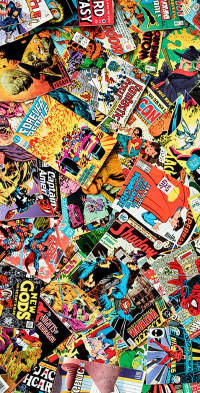 As a subscriber to Mick Mercer’s Panache webpage, I receive regular email updates to its diverse, ever-expanding content. Among the ‘on this day’ photos of Goth and punk bands he took in the 1980s and 1990s and current reviews and photos of the vibrant live band culture around Canterbury and Folkestone (Kent, UK) are his short, sharp and often pithy reviews of a selection of the latest US comics. It was these reviews that were responsible for me delving back into the world of comics, especially The Ballad of Halo Jones. After my revelation of revisiting Halo and realising I knew nothing of current comic culture, I obviously reached out to Mick Mercer for a little bit more info. And that was basically all I was after, a little chat about comics with a man I have huge respect for. However, my innocent questions led me down a path I was not expecting: the world of comic publishing is a whole different animal to that of books.
 Mick Mercer is best known as a music journalist and photographer (Melody Maker and editor of ZigZag) with a career going back to the late 70s, making him ‘…the longest running Goth and Post-Punk Writer in the World’. His photos (available in 120 books) record the nascent London Goth scene of the early 1980s and go up to the mid-1990s. He has written 5 books on Goth and a novel. He has a weekly two-hour radio show that focuses on Goth/Post Punk past and present, supported by a weekly email post called ‘Something for the Weekend’ which contains links to audio and video content of new releases of his favourite genre from around the world. In short, if you have any interest in Goth, Mercer is your man. On top of this he and wife Lynda seem to collect cats, currently 8, whose lives are also meticulously recorded. All of this, and more, can be found for free on Facebook or his Substack (Panache) site but to gain full access for the latter one needs to subscribe.
___________________
TBR: What comics did you read as a kid?
MM: Anything and everything. I basically learnt to read thanks to comics, because the teachers at my infant school were as inept as my parents and nobody spotted I was chronically short-sighted. My parents were actually informed by the staff there that they believed I was ‘educationally sub-normal’ on account of my failing to respond to anything I was asked about during lessons.
I’d seen comic-like books in revolving racks in the area of the library at school, which included some Tin-Tin and Asterix The Gaul, so I would approach the revolving metal racks outside our post office and newsagent and help myself to the comics there, take them home to read, then retrieve more as and when I finished them.
My mother had drilled the alphabet into me and without any help from school the comics then took over. Originally comics reached Europe en masse as entertainment for the dimmer bulbs among the American military and so there were a lot of comics which had very little text but it always goes hand in hand with the visuals, so these made perfect sense to me. Very useful educational tools. 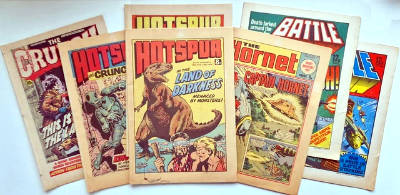
I don’t remember the exact titles I would have read but any of the cartoony ones like Daffy Duck, Bugs Bunny, Quick Draw McGraw, Casper The Friendly Ghost and even the Archie comics with mystifyingly older kids than myself would all have been devoured, and from there I would have gone on to superheroes. I also recall enjoying spooky ones. There was a publishing house called Charlton Comics that did a lot of that stuff like The Many Ghosts of Doctor Graves. Easy on the script and punchy with the pictures.
TBR: Did you read ones like Warrior, 2000 AD, Commando?
MM: All of them, along with standards like the Beano, Dandy, The Eagle (bit boring), Lion, Whizzer & Chips, Wizard, Smash !Pow! And Wham! There were also good black and white Marvel reprints in the form of Terrific and Fantastic. I always got those because the back page was a full colour image of a character and those were all over my bedroom walls. My parents tried to make up for my lack of enthusiasm for junior school (by now I hated those teachers) by getting me a Look & Learn comic every week. Bastards!
TBR: Have you been reading comics all your life or did you return to them?
MM: I read them avidly right through until the mid-90s when I left London to move down to the South coast and help my parents out as they’d become ill. That took years to resolve and meant my circumstances changed so I couldn’t afford comics. They’re even more expensive now but I got back into them a few years ago and make my choices wisely. I’d never lost interest but mainly kept in touch during the quiet period by looking at things online wherever possible.
TBR: Do you read Graphic Novels?
MM: Only occasionally. I prefer the comics, which then go into trade paperback form. Graphic Novels that have never been in comic form would be something that might interest me, but I never go near them.
TBR: Is there a writer or artist you follow? Admire? Avoid?
MM: Not particularly, just now and then. An early Man-Thing artist called Mike Ploog was stunning and I even have a page of his original art somewhere in the house, the only time I have ever felt motivated to splash out on something like that. I guess my current favourite artists would be Stefano Cardoselli and Francesca Perillo who have a wonderfully jumbled style utilising almost pastel colours to create future worlds in which robots often bumble about. I have been collecting their work whenever I become aware of it.
TBR: As you seem to favour US comics, which are always in colour, do you have any opinion of black and white originals, such as most UK comics, being coloured?
MM: No. It all has its place. I was recently disgruntled to find a comic I had bought called Maid Café was all in black and white despite its gory colour cover, but then it’s in a manga style so of course it’s in black and white. I can tolerate anything; I just prefer colour.
TBR: Do you keep the ones you give a nasty review to?
MM: Yes. I haven’t chucked anything away from what I have bought recently. In a way comics are currency. When I die if Lynda wants to sell them, she can do so. That’s part of the idea. I envisage her swearing at a bill that arrives, then shifting a dozen comics on eBay and that’s the situation sorted. I may not personally enjoy certain titles but generally only pick quality so at the very least they grow in value.
I had to sell everything when I moved to my parents as their place was a little bungalow with nowhere for my records or comics and I couldn’t expect friends to store them for me as I had no idea how long it was all going to take. That’s my one main grumble about life. My comic collection wasn’t huge but it was top quality and I could have sold those comics now (which I would have done, replacing the titles with the beautiful Omnibus style book reprints you can obtain) for over a million quid!
TBR: Along with books, CDs and numerous cats where and how do you store reviewed copies? How big is the collection.
MM: The collection is not big. That one I had to sell in the nineties was only seven long boxes, that generally hold about 150 copies each. I think I currently have about eight of them. It slowly grows. I don’t buy a huge amount, maybe fifteen a month?
TBR: I would often find the US ads far more intriguing with Sea monkeys, X-Ray Specs, 7ft tall monsters etc than the actual story. Were you ever intrigued enough to want to buy something?
MM: There are videos on YouTube showing what these things actually looked like! Those are well worth seeing as they’re amazingly crap. I only ever wanted the gigantic Frankenstein poster. At least I wouldn’t have been disappointed by that. I am currently collecting Frankenstein-adorned Hawaiian shirts.
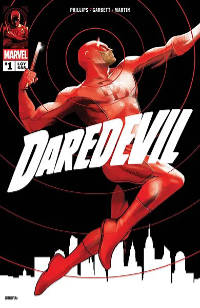 TBR: Of the few American imported comics I liked, Daredevil was my favourite and it seems he is yours too. I can never explain why I liked him above others, any idea why you do?
MM: For me it was easy. He couldn’t see and he (Matt Murdock) shared my initials.
TBR: 2000 AD’s Rogue Trooper is the latest comic hero to be made into film - albeit animated rather than live action. As a comic story is practically a ready-made story board it is amazing the number of total duds that have come out: Tank Girl, Howard the Duck, Daredevil, Flash, Stallone’s take on Judge Dredd etc. I have only ever liked two filmed versions of a comic, the animated Into the Spider-Verse and Jessica Jones season 1. Do you like or avoid movie versions? Is there a character, new or old, that could be film worthy or one that should never be attempted?
MM: I think it’s cinema versus television. Too many considerations go into cinema versions and weaken the possibility of one person having the vision to control a story so you end up with an end product which has been constantly tampered with. The TV version of Daredevil is magnificent while the film version all but made me ill. I came out of the cinema angry! Some of the Thor, Iron Man and Avengers films have been okay, as was the first Deadpool one, but overall you do not expect much anymore.
TV is better, because there’s less chance of it being messed around with. Not that there aren’t duds. She-Hulk (a great comic character) was an absolute stinker. Truly pitiful. Luke Cage was brilliant, and I couldn’t believe how good Werewolf By Night was, especially as Man-Thing also appeared in it and was wonderful. I’d also say The Boys on Prime is quality, it feels like a comic. I bet a film version would be constipated by comparison.
TBR: If there is a cat on the cover you buy it regardless. Have you found any gems with this unique selection method?
MM: No, and I don’t just buy everything but it does pique my interest. I have recently discovered a potentially awesome new mini-series called Red Roots because of the amazing cover art, and the profusion of animals on various covers led me to discover just how entertaining the current Supergirl series is. So, it’s working well.
TBR: What are your current recommendations?
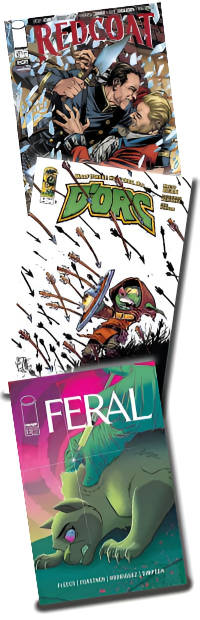 MM: Feral, a tale of a group of cats trying to survive during a rabies outbreak. Redcoat, a solider with a dodgy past who interrupted an occult ceremony during the period leading to American independence and found himself accidentally made immortal. One of his best mates is Sigmund Freud. Hyde Street, a modern horror thing that I don’t fully get but love the art and will re-read to get more out of it at some point.
I still read Daredevil but wouldn’t actually recommend it to anyone as it’s often too predictable. D’Orc recently had everyone suspicious when the first issue was barely in the shops but was instantly fetching over a hundred quid online, but it is a wonderfully funny and imaginative story of a creature that is half dwarf and half orc and could, potentially, bring about the end of the world. He doesn’t know why and he’s battling to try and ensure everyone just wants to get along.
I also think everyone should be reading Absolute Batman. Then again, in the comics world pretty much everyone already is.
My all-time favourite comics are/were Daredevil, Man-Thing, Werewolf By Night, Moon Knight and Howard The Duck. Of these only Daredevil and Moon Knight are in regular publication. The others pop up occasionally.
Comic publishing has changed. New series rarely get into double figures and mini-series are all the rage. When a long-standing character like Daredevil has a ‘current’ series’ that is running out of steam in terms of sales they find a way to abruptly end that volume, and then they bring him back a year later relying on the fact extra people rush to buy the new Number One of that Volume. It’s a crazy and frustrating system, especially for anyone trying to collect anything retrospectively. Daredevil must be on Volume 9 by now? They could simply have carried on with the original numbering system and paused publication, but now we have this mess of a system.
TBR: You say everyone should be reading Absolute Batman and call it ‘Brilliant’. Why? Isn’t it just a regurgitation of the same old same old? Milking a character dry? As done to Superman and the endless variations: Superman, Superman (his son), Super-man (Chinese teenager) Superwoman (x3), Supergirl, Superboy, Krypto the bloody Superdog, Streaky the Supercat and possibly Hammy the Superhamster?
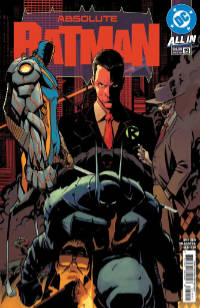 MM: No, this is different. The Absolute series takes a well-known character (Batman, Flash, Supermen, Wonder Woman, Green Arrow etc) and turns it on its head. In Absolute Batman he’s no rich kid growing up in a mansion having been heir to a business fortune. This Batman is a construction worker who has become pissed off by all the crime around him and decided to do something about it. He becomes such a menace to local crimelords they pay him off if he’ll leave them alone for a set period of time, which he agrees to so that he can invest that money in equipping himself better for the fight ahead. His Batmobile is a souped-up Monster Truck.
All the well-known Batman adversaries are slowly introduced but these are darker, dangerous versions of what you might have seen before.
I would definitely recommend Absolute Batman to anyone.
TBR: Were you aware of The British Invasion (comic book writers and artists, not the Beatles) in the mid to late 1980s?
MM: Yes indeed. I was reading all the time and regularly in and out of the comic shops in London. In fact when I was about thirteen I started bunking off school to visit Soho and hang around in a shop called Dark They Were & Golden-Eyed. It was a sci-fi bookshop but downstairs had a huge comic section. From there I picked up knowledge about other shops and comic marts, and also started buying British comic fanzines.
In the eighties I tried, and partially succeeded, in getting Melody Maker to let me review some comics in the tiny book section, but they wouldn’t let me do it regularly, even though comics had suddenly become cool enough for non-fans to hear about their new relevance around the time of The Dark Knight Returns and Watchmen.
TBR: You bemoaned in a recent batch of reviews that recent comics ‘can be under or over-written, with plot getting in the way, or minimising action. Male characters tend to be the worst offenders, over-thinking things, while female characters are much more direct, which I think explains why the current Black Cat, Catwoman and Supergirl series are such a delight. They remind me of the Marvel stories from the 70’s, having depth but getting the basics right to ensure they feel light, bright and something you don’t want to miss’. A couple of things come out of this. One, are those particular heroes aimed at a female readership or is it still predominately a male audience? And two: This seems, along with ‘light and bright’ like a reversal of the over-thinking male introduced in the 1980s British Invasion. Is there a return to simpler basics around the corner? Would you welcome it?
MM: Some writers have got too full of themselves at times regarding themselves as important as the characters they’re handling, and this is where things go wrong.
I don’t want to see a return to simpler times, I just want to see the characters honoured and in imaginative stories but there is a dearth of quality writing out there and a ton of inconsequential fluff. It takes a great writer to create a simpler story. It takes an average writer to mangle something beautiful.
In theory they should know better. I know Marvel has a style database that writers are supposed to consult when writing a comic of a character they’ve never done before, and I imagine DC have a similar thing. This is to ensure continuity of the character, but some writers ignore this and suddenly a once headstrong character becomes a weeping self-hating idiot, or a thoughtful one goes totally gung-ho. That puts me off.
Comics are aimed at everyone, but the male side of the audience do tend to be the ones who have YouTube channels where they moan about comics having gone too ‘woke’, apparently too thick to realise that comics have always been in the vanguard of wokedom.
TBR: In a recent review of a Jessica Jones issue you say it ‘actually deserves its red band’, referring to the explicit content warning. Elsewhere you grumble about a devious plot to artificially rig the price of a new first issue as well as comics having different covers and sold in bags. This all seems to be a world far removed from a product for kids, and one aimed purely at adults and collectors. Is there something rotten in the state of comics?
MM: Not rotten, but financially motivated in a way I feel is part desperation and part driven by comic speculators. Around the time of the pandemic it seems people started using their time to speculate on comics and there was a huge increase, for example, of people getting their comics graded and ‘slabbed’ using either CGC (Certified Guaranty Company) or CBCS (Comic Book Certification Service). This finds people sending their comics off to a recognised grading firm who then return the comic in a sealed plastic slab and the grading (the highest generally being a 9.8) is recognised throughout the trading community. It’s been used for sports cards for a while but the popularity for comics grew during lockdown and it pisses me off, as people started buying up first issues of series and rushing them to get slabbed, or buying ‘key’ issues (first appearances of characters in the main) and this started driving prices up.
Then the inevitable as some dealers got their comic graded with the seal of ‘authenticity’ but then cracked the slab open and put a comic of a lesser condition inside and returned the slab saying they’d damaged it and paid for the case to be re-done (not the appraisal) and they were returned an average comic in a case still stating it was 9.8. Suddenly slabs were somewhat pointless and untrustworthy for people obsessed with the financial side of comics.
It’s the same with ordinary comics and the ‘variant’ issues. Virtually every comic released these days comes with the A cover, which is basically all we got in the old days, but then came various alternative covers by other artists (the comic inside being identical). A recent Superman issue had covers A through to Z. This is purely the publishers trying to maximise potential profit. They rely on advance interest in the comic to judge how many alternatives to print.
The thing is you have the real comic inside the variant cover. So if a comic suddenly becomes madly popular, and the A issue is always the most collectable one from that moment on, if anyone had bought a variant cover all they have to do is remove the variant cover and hey presto, they have an A cover version.
So, the market is in a state of flux through trying to find ways to help comics remain profitable.
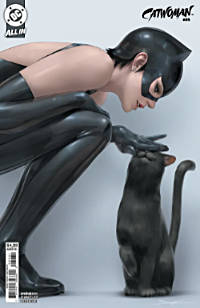 Personally, I just buy the A cover. I would never consider having a comic slabbed as you can no longer look at it! Everyone knows there are financial implications associated with comics, but I buy what I love and want to collect or think will be an interesting comic and I want to review that and tell people about it. Some will rise in value, others won’t. Big deal. I occasionally, very occasionally, buy another cover when the art on it is stunning, or in Catwoman’s case I’ll select whichever issues feature artwork featuring cats. I just ordered Catwoman #89 cover C because the cover A had no cat.
I see huge problems ahead for collectors in the future, as when they go to look of for a specific issue, they’ll have to work their way through listings or info for so many different versions of one issue. It could become a logistical nightmare inside the trade generally.
Buy what you love, and forget about everything else, that’s my approach. Comic speculators are a cancer that need to be eradicated.
TBR: Blimey! It’s worse than I thought! I thought it was the publishers meddling but to find it was purely speculators, rather than readers, who possibly don’t even care about the contents is, frankly, awful. You said keep ‘comics profitable’ which again focuses more on future value and seems far removed from the days of a young teen wandering into a newsagent and buying a random comic to simply read and enjoy. Are those days finished?
MM: Publishers need to keep comics profitable or there’ll be no more comics! Hence the variant covers, and the way series are ended quickly if the sales figures go down. I can see why they do that. The speculation side of things has been a cesspit, but I believe many fingers have been burned recently and it seems to be slowing down. Also, comics cost a lot. The cheapest I get through Forbidden Planet are £2.65, then the next price band seems to be £3.30, and it’s not uncommon for some chunkier issues to be over £4, so nobody sensible buys too many a month!
They stopped selling to newsagents pre-noughties which must have restricted audience reach. If you are lucky enough to find anything in a newsagent these days it may be Marvel reprints, and then what remains of the regular British comic market aimed at kids and older. Comics went ‘direct market’ because of distributor deals back in the 90s, so everything goes through comic shops now. These come and go as they did back in the 80s. Of all the places I used to visit personally only Forbidden Planet and Gosh! exist in Central London. (I buy my comics through the Forbidden Planet mail order website.)
I do think they still serve the local audience well, and you probably have a shop somewhere near you, which will also sell action figures, games and the like, especially the future car-boot sale favourite of the future, Funko Pops. We have two near me, one in Folkestone, one in Hythe, and you get the full range of Marvel, DC and all the main independents, as well as British black-and-white self-published titles and fanzines.
There’s loads of YouTube channels devoted to comics, most of which concentrates on the financial side of things rather than someone simply reviewing actual comics. I like the Comic Book Palace, done by a generally disgruntled man who runs a comic shop in America and on Tuesdays he goes through the week’s releases and slates anything he regards as woefully inadequate. Then you have the beacon of positivity Mike who does Comic Book Corner 2.0, which pretty much has a new video every day and he’s a genuine fan. I would also recommend Economics In Comics and Comics With Bueller as two channels that keep you as up to date with new upcoming releases as you could wish for.
The one positive sign I have seen during the last year is a lot of people bemoaning their own stupidity at having got caught up in the whole slabbing and speculating side of things. There are still a lot of people who see comic collecting as a thing, rather than comic buying because the actual comic is the thing which really matters.
Incidentally, I was horrified back in 2019 when I had my heart attack (ticking that off the bucket list) to be laying in hospital when the man with the magazines and papers came round. I opted for buying The Beano and couldn’t believe how feeble it was. By contrast I got a Simpsons comic the next day and that at least had a sense of the show’s spirit. I have also seen some of the Commando war comics which still come out (with moderated language) and as well as the war stories they have contemporary anti-terrorist adventures.
Cheers!
Mick
_____________
Thanks Mick. And I thought the disappearance of the local bookstore was bad. What is extraordinary, considering the minefield of varied choice and versions in a specialised market, is the lack of reviewers.
I can now fully understand why a character, and cash cow, such as Batman needs to be retained but totally rebuilt, and have followed Mick’s advice and have ordered, and currently waiting for, an Absolute Batman. On hindsight, that aspect is not that different from books if one takes Tarzan, set in Africa in 1888 but flying fighter planes against the Japanese in World War II.
What is different is the idea of a choice of covers for one edition. Different covers of the same release are seen in the magazine and music world and people do buy various versions of books simply for the cover of reprints or movie tie-ins, but I don’t think a single edition of a book, hard or paperback, has yet appeared with a multiple choice of cover. Meaning a collector would be forced to buy all the covers of the first edition, not just a single book. I wonder how long before that happens?
© Garry Smout for TBR
This interview may not be archived, reproduced or distributed further without the author's express permission.
Please see our conditions of use.