


 MILENA NIGAM
WILDFIRES
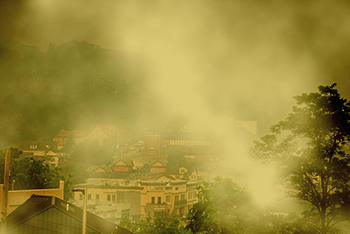
The smoke from the Canadian wildfires settled over the city mid-morning. We’d had clear skies and sun at breakfast, and then, almost at once, the house darkened, and out the window there was the brown-gray of something that felt altogether different from weather. When I opened the front door, particles from the distant fires jabbed pinpricks of pain into my nostrils and down the deepest passage of my throat. I shut the door before the cat could get out.
During that time, my lungs were already coated in toxic particulates. We were renovating the kitchen in our 130-year-old house, and the contractor and his team had taken the room down to its studs: crumbling brick and dark wood beams that didn’t look strong enough to hold a gymnast, let alone the two expansive floors that bore down from above.
My husband and I had argued all spring about the renovations. We shared the same vision, and the creeping costs wouldn’t compromise our finances for the long-term, but I’d become very much a good-enough person in middle age, whereas his tendency for perfection had tightened to a choke hold around his ability to move forward on anything without multiple checks and cyclical research and contingency plans ad nauseum. Neither of us brought the healthiest approach to the kitchen project, but at least my looseness allowed me to still get seven hours of sleep at night, whereas he sat up with the cat in the dark, emailing our contractor with multipoint directives.
The Air Quality Index that first smoky day was just under 300. The highest I’d ever seen before in Pittsburgh was 70, and that, only when the wind patterns were especially deviant, carrying pollution from the coke plant up the river right past our neighborhood. My husband and I had traveled to India a few years earlier for his nephew’s wedding, and we’d landed in daytime darkness in Delhi, the air impenetrable with an AQI of 500. I never thought to see something even remotely close to those numbers in Pennsylvania, but there we were. I refreshed the weather app throughout that first afternoon, astounded by the reports from the wildfires. Parts of Michigan were registering in the mid-600s. My eyes stung inside the house, even with the air conditioner running, although part of the problem inside was probably the construction dust.
There was another thing adding to my sense of instability. I had lost my mother’s watch. It was a tiny-faced thing made of gold, with the initials from her first marriage engraved on the back. She’d been married in college, something she didn’t tell me until I was in high school. The marriage lasted only a year and had ended amicably. They were simply too young. My grandfather, more than anyone however, had been devastated by the divorce—he’d put a bottle of champagne in the fridge the day my mom and her college boyfriend drove home for Thanksgiving with “an exciting announcement”—but my mom never doubted my grandfather’s unconditional love. Unfortunately, the same could not be said for how I experienced my mom’s love for me.
The watch, I’d worn since college. Its modest size fit the small bones of my wrist, and it had a lightness to it that was never distracting, just substantial enough to ground me. My mom’s family had been well-off but not my family growing up, and the watch was the most expensive thing I owned until the diamond engagement ring from my husband. Now, thirty years after my own marriage, I’d collected an embarrassment of jewelry, mostly gold from my Indian in-laws, but my mom’s watch was what I put on every morning, without fail. And every night I kept it in a veiny, raku-fired dish next to my toothbrush.
We’d rearranged things in the house to accommodate the renovations, and even our general routines were upended. For example, we were washing dishes in the bathtub, which meant we carried things from the basement fridge to the grill outside to our dining room table to the garbage can in the garage, and finally to the bathtub to wash and dry before carrying everything back down to the basement. When the watch wasn’t next to my toothbrush, I could only imagine having taken it off somewhere unusual during dinner clean-up the night before. I checked next to the bathtub. I checked the dining room. I even checked inside the fridge, thinking it would’ve been a funny place to put it, but I was distracted enough by the construction mess that anything was possible. The watch was in none of those places.
It won’t be a surprise to know that my husband is very good at finding things. I told him about the watch, and he walked methodically through each room, ignoring the kitchen because it was taped off with plastic sheeting and lined in plywood. No watch. I stood outside on the front steps to take in the darkening smoke and didn’t hear a single bird, not even the Carolina wrens who’d been shouting at each other in the knotted winterberry shrubs since spring.
The next day was more of the same. Our construction-dust-patterned footprints marked our journeys from the living room to the dining room to the bathroom off our bedroom upstairs while we sheltered inside from the toxic air outside. The watch was still missing. I stared through the window at the perfectly circular sun that burned mutely behind layers of brown smoke. The cat meowed at the door, not satisfied when we told her it was too dangerous to go out without a mask. The kitchen team played the radio at half-volume while their power tools cut clean lines through the brain matter in my head, forcing my grasp at cohesive thinking into a collapsing gelatinous goo. My husband worried over an eighth of an inch of countertop in the design plan, and I felt as separate from his obsessive checking as I did from the offensive lyrics coming from the construction team’s radio. I waded through the brown-gray soup without a destination. The mail arrived, and there was a letter from my sister.
My sister and I hadn’t spoken regularly in almost two years. The way I tell the story, she was upset at how her teenage daughter had been sneaking out to boys’ houses when the parents weren’t home, and she—my sister—had shared with me the only way she could think to get a handle on the situation: to threaten to send her to boarding school. I thought my niece’s behavior wasn’t anything extreme—she was a teenager—but my sister told me I had no experience from which to speak. My sons were already through college, and in terms of rebellious behavior, there’d been nothing more than ear piercings and dating people who weren’t that serious about their futures. I’d had it easy as a parent, she said, and she was mostly right. But I wasn’t without perspective, having still raised two children, and I told my sister she’d regret threatening something she’d never be able to follow through on.
“Oh, I would do it,” she said. “She needs to know there are consequences if she keeps lying to us.”
The sneaking out had only happened a handful of times, as I’d understood it. I said again, “Don’t say something you’ll regret.”
“How about, ‘Fuck you’?” she said, and hung up the phone.
I gave her a cooling off period, but maybe I waited too long. When I finally reached out to see how the situation was going, it had been a few months, and at that point all I got back from my sister was the blunt response: I’m taking a break from you. I texted her back, and she responded, I’m serious, then blocked my number. I was surprised and a little pissed, and while I still sent birthday and Christmas gifts to our nieces, and birthday cards to my sister and our brother-in-law, their silence was upsetting and, personally, I lost interest in trying to figure my sister out.
Something heavy fell in the kitchen. I took the letter upstairs to the bedroom and turned on the bedside lamp. Outside, the smoke pressed into the windows like a theater going dark. I traced my wrist where the watch usually sat. My sister and her husband were separating.
You must know how judgmental you are, she wrote. Please be kind.
My brother-in-law had been gambling their savings on online sporting apps. I gasped at the news, that’s how crazy it felt. He’d always been a good guy, maybe a little flashy. I learned about it through one of the parents at the girls’ high school, a dad Rowan confided in. She’d been totally blindsided, but I had trouble, holding her letter in my hand, understanding how that kind of thing happens unnoticed. My sister was in banking. They had a big-time financial consultant to watch over their wealth. How long must her husband have been depleting their accounts without anyone raising a red flag?
The girls’ 529 accounts were spared, she wrote. I still have my job. We’ll have to sell the house. The change in our wealth is shocking, and I know this will, in some ways, come to define us. But right now, what I can’t tolerate is the embarrassment. The overwhelming shame that this man is my husband. That there was a moment when I chose him. That I ever loved someone who could do this kind of thing to his family.
I could hear my husband with the contractor downstairs, their voices echoing through the floor under my feet. A word that sounded disturbingly like asbestos, then more talking. Finally, my husband’s booming laugh. I thought about how to respond to my sister. What words could I use that wouldn’t be read as me judging her? I pretended to myself that I didn’t judge her. It was my brother-in-law that deserved condemnation. My husband said something, and the contractor responded. My husband said something else, and I knew he’d had the last word about something. Soon after, a drill squealed like an electrical current shattering my thin bones, and I returned my sister’s letter to its envelope.
In Delhi, squeezed in from all directions by the stifling air pollution, the nephew’s wedding had been all about the bride and groom, but not for the bride and groom. During the reception, the bride sat on a stage in red and gold, diamonds and rubies falling from her ears and collaring her neck. Her makeup and expression so perfectly stilled for the many professional photographers and videographers to capture. My husband’s nephew processioned in wearing a stiff white turban topped in feathers and a long, white robe embroidered in rich, gold thread. Women acrobats preceded him, cartwheeling and backflipping and holding sizzling sparklers out to the sides, the guests clapping and dancing for the spectacle, music pulsating, and the smell of roses mingling with the smog as the procession trampled kilos of red and pink petals adorning the ground. When the groom finally reached his bride, the couple sat blandly side by side while the hundreds of guests watched a video to the right of the stage of a reenactment of the couple’s romance, from their meeting at a student political club to their first date at the fast-food chicken shop, to their many celebrations with university friends. It was like we were watching two performances: the film and the couple sitting formally on stage.
Days later, we flew home, rising above the city through the brown sky at midnight. Before the smog completely engulfed us, we could see the bright lights of other wedding ceremonies. Tens of them, then hundreds of them if you looked far out over the plane’s wings. That month had been an auspicious time for marriage; in a country of 1.4 billion people, there were five million weddings that November alone.
When my husband and I got engaged, my mom left a voice mail for my husband’s parents, a recording my father-in-law recently shared with us. There was my mom’s voice, gushing about how wonderful my husband was, how thrilled she was to have him join our family.
“What a deeply, deeply special person he is,” she said. “And,” she paused, “I guess he sees something in Steph. Since he asked her to marry him.”
I mentioned my missing watch to the contractor.
“In case any of your guys see it,” I said.
We’d known each other for a long time, but I could tell he read mistrust in my words. I’m becoming sloppy, I almost said. It’s probably just lying around somewhere. But we both knew the opposite could also be true. That someone had taken it.
I told my husband about my sister’s letter.
“Fuck,” he said.
“I know.”
“Are you going to call her?”
“I don’t know,” I said. “I’m not sure what I’d say.”
“That’s messed up,” he said, not about my reluctance to respond to my sister but to the situation she was in.
We sat together thinking about what our brother-in-law had done, communicating something unsaid between us that I knew was ugly but we also both honestly believed: our general superiority. Neither of us would burn up our savings like Rowan. The kitchen renovations were costing the equivalent of putting another child through four years of college, but we’d already put our kids through college, checked that off the list. It was smart to be investing in the house. Like paying for college, these were investments in our family. Our marriage was another investment.
We had a neighbor who was a good friend of mine, another mom of adult children and also a bit of an artist. She did what she liked and never asked permission first. In terms of her art, she took photos of everyday people, more women than men, eating outdoors. I’d posed for her once with a bowl of fresh lychees, standing under the bucket at the spray park by the city tennis bubble. Lychees are delicious, and these were in season; she’d bought them at one of the Asian markets in the Strip District. All around us, kids were screaming, crazy-running in and out of the water fixtures in their bare feet and bathing suits.
My friend had me peel each lychee individually, then tear off the flesh from the round pit as the bucket over my head filled with water. I’d worn a black dress of thin cotton. Each time the bucket hit its tipping point and water dumped suddenly, I lost my breath, inundated by the cold flood. My long hair clung to my face and neck, and the dress stuck to my body like plaster. I guess it sounds sex-charged here, but at the time, it felt innocent and fun and we spent a lot of time laughing. I tried to make sure I didn’t drop the bowl of lychees, but I did have to pour the water out before I peeled and ate the next sweet nugget of fruit. Parents ignored us the way they were ignoring their kids. Kids ran back and forth asking what I was eating. What I was doing. Why I wasn’t in a bathing suit, and did I know my dress was getting wet?
“My friend’s a photographer,” I told them, pointing to my neighbor behind her camera.
“Take my photo! Watch me swim,” they cried, slapping their wet feet against the squishy rubber playground surface, but my friend told them she only took pictures of grown-ups.
No one was at the spray park during those smoky days. No one was outside at all. The guys working on our kitchen wore masks when they unloaded floor tiles and gallons of adhesive, additional calking guns. I wondered whether my watch was in one of their trucks. Or maybe just fallen beneath a pile of old drywall. An HVAC team arrived to replace the air vents, and they told us that when the renovations were done, we should put in new filters in the air exchange, otherwise the construction dust would continue to coat our books and coffee table and hardwood flooring with the lightest layer of white, noticeable every time we swiped a finger across a surface.
I don’t like remembering it, but my husband thought about leaving years ago, when the kids were still at home. He’d had an existential crisis: Had we married too early? Were we too different from each other now; did we connect on a level deeper than the everyday tasks of raising a family? The sex was good, but didn’t we want great? The questions became all-consuming, and he binge-bought relationship books on Amazon as well as lube and toys from an internet sex-positive store. He wanted to have sex in the middle of the day between meetings since we’d both been working from home after the pandemic. He worried in impassioned whispers at night that he just didn’t know how to bring us closer.
Before the crisis, I thought we were doing pretty fine, and then as he started to question everything, I lost my footing. I wasn’t interested in sex toys, and the occasional afternoon tryst was OK, but he made it a requirement and practically graded our experiences to calibrate whether we were improving empirically on that front. It got to the point where I felt like I couldn’t be myself, couldn’t be honest with myself about what I liked or didn’t like, as if his needs were the only ones that got to drive our marriage.
I fought in my own muted way, however, for him to stay. My arguments weren’t earth-shattering. The kids. Our history. Soon we’d be empty nesters, a whole new chapter to the relationship. I think, in the end, my husband likes the challenge of making us great, even though that challenge has taken him through some exhausting manic periods and moments when he acts like he hates me. But like the kitchen, he seems to think the pain is worth it; we’ll have as close to perfect as he can ensure.
It was quiet in the house after the kitchen team packed up for the night, but the suspended smoke gave the impression of movement, like something was stirring in the otherworldliness. We grilled shrimp and zucchini for dinner, wearing leftover COVID masks for those minutes we had to spend outside. I ran the dishes under the bathtub faucet while my husband dried everything and carried them back down to the basement. Normally in the summer, we sat with things getting dark in our backyard until the mosquitoes arrived, but the air was too abrasive so we stayed inside, wasting time on our phones.
“You should call your sister,” he said, scratching the cat, who was dreaming of wrens.
“I know,” I said, but I knew I wouldn’t do it that night. I swiped through cities on the weather app, watching the AQI scores slowly lessen.
I went upstairs to look for my watch again. When my mom died, I inherited her work wardrobe. I searched through the pockets of her cardigans and jackets, even though I hadn’t worn these clothes since pre-pandemic. At that point, it felt like the watch could be literally anywhere. I pulled out an unused Kleenex from one jacket pocket, a hair elastic knotted with hair from another. The clothing hadn’t been cleaned in a long time, and things smelled a little stale, a little bit like particleboard.
From the bedroom window, I could see into my neighbor friend’s backyard. She’d planted kale and garlic in a galvanized tub, and the early-season tomatoes were starting to form fruit. The screen of pollution washed everything in the same brown twilight. While I was spying on the garden, a woman walked into their yard with a glass of wine. She was young but I couldn’t tell how young. Maybe thirty. Maybe younger. She wore short shorts and heels that sank into the grass and made her laugh over her shoulder. I held my breath, but it was all so obvious. Out walked my neighbor’s husband, tall and smug like a politician even though he was just a local orthodontist, holding up his own glass of wine.
The setting sun behind them turned the haze a streaky red and orange, just like a fire.
The morning after the wedding in Delhi, the bride cried heartbreaking, wrenching tears when it was time to say goodbye to her family. She sobbed during the car ride to my husband’s nephew’s house, where the couple would live with my husband’s cousin, the groom’s mother. When we arrived that morning for a new round of blessings, after a sleepless night of ceremonies and buffet food smoldering with chili powder, the bride’s eyes were puffy and red. The groom moved around her quietly, tentatively, while his mother talked loudly as if nothing were amiss.
“Every bride is like this,” she told us, laughing and patting her new daughter-in-law on the arm. “If she weren’t sad, her parents would take offense. We’ll open gifts and have tea, and she’ll be very fine. Don’t worry.”
The bride’s devastation upset me for the prospects of the marriage. How could they already be off to such a poor start? But she took a nap in her new room, and by the time tea was ready, she and the groom were smiling secretly at each other, whispering together. She helped her mother-in-law to serve the guests. When it was time for gifts, I followed what others were doing and went to her on my knees to share my wishes for their marriage and to present her with a small pair of earrings I’d guarded in my carry-on all the way from Pittsburgh.
“May you have many years of happiness and love,” I said, self-conscious and moved by ceremony. The couple’s future seemed so fragile, their youth such a liability.
Outside the house, people sat on broken curbs, choking on the gray pollution like any other day. Inside, we gifted the couple jewelry as shiny and bright as the hidden sun.
“Auntie, thank you for coming to our wedding,” she said to me, like the wedding had been the culmination of all she’d ever wanted, the marriage ahead of her just unobstructed air.
My mom once told me you only choose one person in your life, your partner. She didn’t have many lasting friendships, and she held her two daughters at a strange distance, like she could only love us if we gave her a good reason. I went into my own marriage with the heavy responsibility of making sure it lasted. And still, as I got older and came more into my own, more confident in my individuality, my marriage suffered. Maybe it wasn’t all my fault, but my husband’s doubts about whether the relationship was as good as we deserved made it feel like the burden was on me.
I had to find the watch. It was dark now. All I could see in my neighbor’s yard was the weak yellow flicker of their gas fire table. I opened the top drawer of our dresser, pulled out my husband’s boxers, dropped his rolled socks on the floor. The next drawer was mine: underwear, bras, saved birthday cards. I went through our bedside table: the scrunched-up receipts and charging cables, the stack of relationship books, the sex drawer with towels and our vibrator, a rubber spoon for spanking. All these things spoke of what needed to be fixed: my apathy, my lack of sexual originality, how hard it was to love me.
I pulled the blankets off the bed, took the pillows out of their cases. My husband came upstairs.
“What are you doing?” he asked, the bedroom now a complete mess.
“I can’t find it,” I said. “I can’t find my watch.”
He picked up the two pillowcases. “But you never wear it to bed.”
“I know,” I said. The tears that had started to fall felt thick with dust as they rolled down my cheeks. “What if you leave me?”
“What?”
“You almost left me,” I said. “I don’t know how to make you stay.”
He sat down on the stripped bed. “That was years ago. I made a mistake.”
I wiped my face and sat down next to him. The warmth of his legs next to mine helped quiet the anxiety in my chest. We’d been together a long time. “Our neighbor’s having an affair,” I said.
“No,” he said.
“Some cute young thing.”
We rested our heads together. A middle-aged dentist whose wife was out of town? We’d never be so predictable.
I called my sister.
“I got your letter,” I said. “I’m so sorry.”
“What can you do?” she asked. “The girls need me to keep it together, so I’m keeping it together.”
“Am I allowed to say he really fucked up?”
“He really fucked up,” she said. “But the joke’s on me.”
“No,” I said. “The joke’s on him because you’ll rise from this. Out of the ashes.”
I chose not to tell my neighbor about what I’d seen her husband do. It wasn’t my business. She did take my photo again, however, weeks later. My request.
I was thinking I could take something for my husband, suggestive shadows and slim thong lines, but when I looked through my closet, I felt for a soft gray T-shirt that hung wide and loose in the V-neck. I dug up the bangles I’d bought for the Delhi wedding. The tiny shop had been lined floor-to-ceiling in glass bracelets: blues and pinks, turquoise. Two shopkeepers studied my wedding lehenga, then one got on a stepladder and handed down box after box of bangles. They built me an arm’s length of yellow, green, and gold to match my fancy clothing, and at the time, I would have paid any amount for the beauty they created. Later, we walked around the back of the shop before returning to our hotel and came across a disaster of jumbled wires and broken electrical boxes. My husband snapped a photo for our contractor, who, at the time, was renovating a different part of our house.
Fire hazard, anyone? he’d texted.
Our contractor replied with a head-exploding emoji.
The burning smells from Delhi traveled home with us on our clothing and took two washes to disappear completely. The lehenga had to be dry-cleaned. My neighbor’s rug, where I posed for my photos, was cool against my bare legs, and smelled like somewhere far away—black tea and lemongrass, perhaps. I wondered if the husband had lain there with his young thing. When I shifted to get more comfortable, the glass bangles swept down my arms with sounds like bells.
“Do I look OK?” I asked. My hair was partially uncombed; I’d given up on makeup. I could feel my heart flicking nervously. “Are the photos OK?”
“You look like you,” she said behind the camera’s viewfinder. “Dan’s going to love them.”
The wind eventually carried the smoke away. The Canadian wildfires dimmed, reignited elsewhere. The contractor finished laying the floor and hanging the cabinets. Some days the smell from something being cauterized made my eyes itch. We continued to follow the paths our footsteps made in the layer of dust on the hardwood floors. When they brought in the granite countertop, it fit like a glove. My husband’s eighths-of-inches held solid, but it doesn’t mean the renovations were perfect. We’d forgotten to plan for where our silverware would go, and the hanging pendant light over the kitchen sink was way too small. It’d been my job to check the measurements on the lighting order, and I’d seen the dimensions but hadn’t believed them because the online image looked fine to me.
My husband keeps the photos of me on his phone where he can look at them whenever he wants. He thinks they’re pretty sexy, and I kind of agree.
We never found my mom’s watch.
© Milena Nigam 2026
This story may not be archived, reproduced or distributed further without the author's express permission.
Please see our conditions of use.
Author Bio
 Milena Nigam is a Pittsburgh-based writer and the managing editor at Autumn House Press. Her work has appeared in Prairie Schooner, The Forge Literary Magazine, The New York Times, Off Assignment, Litro, and elsewhere; her short story, "Switchbacks," was nominated for a Pushcart Prize. She has been a fellow at the Virginia Center for Creative Arts and is an alum of the Sewanee Writers' Conference. Milena is currently an MFA candidate in the Bennington Writing Seminars.
The Barcelona Review is a registered non-profit organization